
Evolution API vs WasenderAPI: The Architectural Decision Guide for SaaS
Navigating the WhatsApp Infrastructure Dilemma
When a SaaS platform, marketing agency, or enterprise scales its conversational automation, infrastructure decisions become critical. What starts as a simple script to send a few notifications quickly evolves into a mission-critical communication layer. At this inflection point, engineering leaders inevitably face a crucial evaluation: Evolution API vs WasenderAPI.
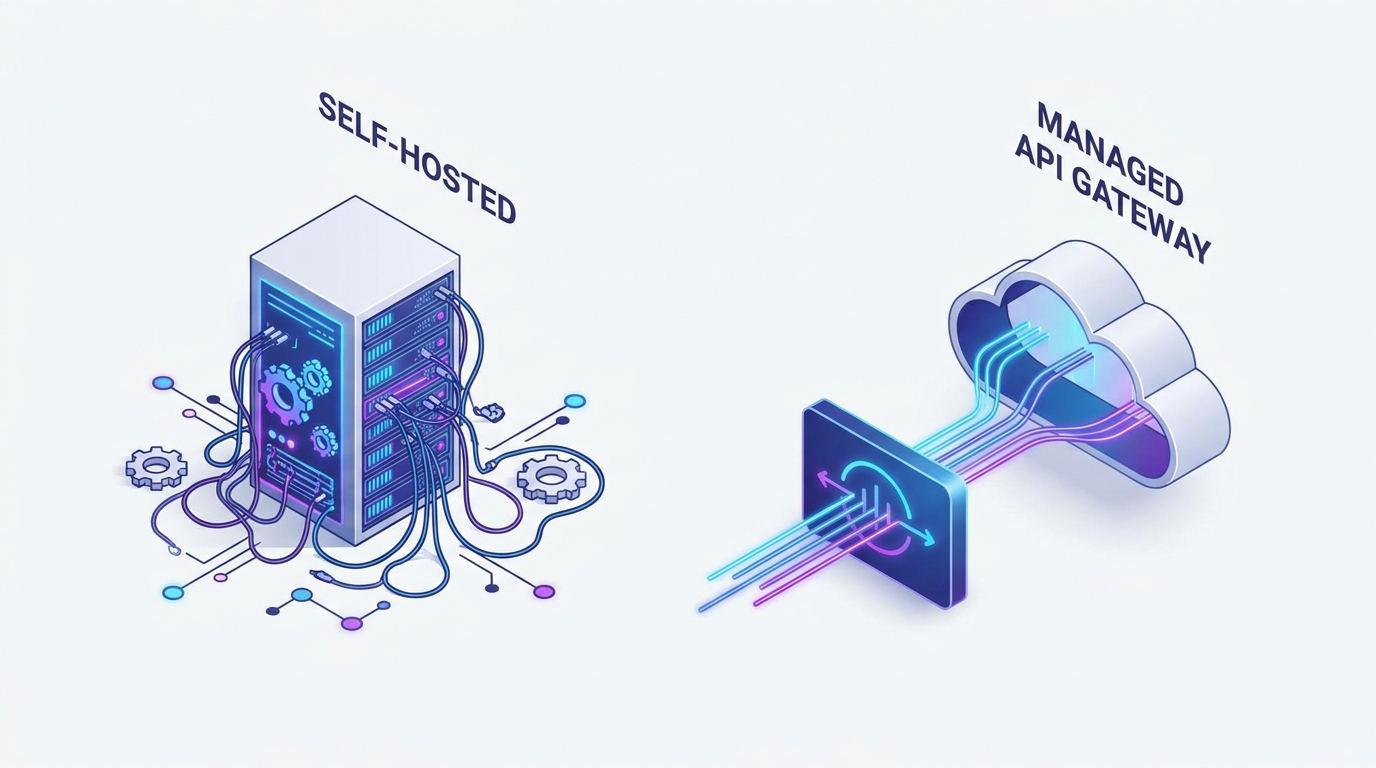
Both solutions enable developers to connect applications to WhatsApp, bypassing the rigid restrictions of the official Cloud API. However, they represent two fundamentally different architectural philosophies. Evolution API offers an open-source, self-hosted approach, while WasenderAPI provides a fully managed, multi-tenant gateway designed for immediate scalability.
In this guide, we will break down the technical trade-offs, infrastructure requirements, and business impacts of both platforms. By the end, you will have a clear framework to determine which architecture best aligns with your engineering resources, high-volume messaging needs, and long-term product roadmap.
The Core Difference: Self-Hosted vs. Managed Gateway
To make an informed decision between Evolution API and WasenderAPI, you must first understand how they handle the underlying connection to WhatsApp's web protocols.
Evolution API: The Self-Hosted Open-Source Wrapper
Evolution API is a robust open-source project built on top of the Baileys library. It acts as a wrapper that translates WhatsApp's complex socket connections into a usable REST API. Because it is self-hosted, you are entirely responsible for the infrastructure.
- Infrastructure Ownership: You must provision, monitor, and maintain the servers (e.g., AWS EC2, DigitalOcean Droplets).
- State Management: You are responsible for managing Redis or PostgreSQL databases to store session data and connection states.
- Maintenance Burden: When WhatsApp updates its web protocols, your team must manually pull the latest Evolution API updates, test them, and deploy them to production to prevent downtime.
WasenderAPI: The Managed Multi-Tenant Gateway
WasenderAPI is a fully managed API gateway engineered specifically for SaaS platforms and agencies that need to manage multiple client sessions simultaneously without the DevOps overhead. It abstracts the complexity of the underlying socket connections and server maintenance.
- Zero-Infrastructure Overhead: The platform handles all server provisioning, load balancing, and scaling automatically.
- Managed Session Stability: WasenderAPI continuously monitors session health, automatically handling reconnections and state persistence.
- Built-in Multi-Tenancy: The architecture is designed from the ground up to support hundreds or thousands of distinct WhatsApp sessions (QR codes) under a single master account, making it ideal for white-label SaaS applications.
Architectural Trade-Offs for High-Volume SaaS
When evaluating Evolution API vs WasenderAPI, the decision rarely comes down to basic functionality—both can send and receive messages. The true test lies in how they handle scale, concurrency, and edge cases in a production environment.
1. Session Management and Concurrency
Handling a single WhatsApp session is relatively simple. Handling 500 concurrent sessions for 500 different SaaS clients is an architectural nightmare if not designed correctly.
With Evolution API, multi-session management requires significant vertical and horizontal scaling. Each active session consumes RAM and CPU. If a single node goes down, all sessions on that node disconnect, requiring clients to re-authenticate. You must implement custom clustering, sticky sessions, and robust database-backed session storage to ensure high availability.
WasenderAPI eliminates this complexity through its managed multi-tenant architecture. Sessions are isolated and distributed across a highly available cloud infrastructure. If a node experiences an issue, sessions are seamlessly migrated, ensuring that your clients rarely experience unexpected disconnects. This allows your engineering team to focus on building features rather than debugging socket timeouts.
2. Message Queueing and Rate Limiting
High-volume marketing campaigns and retention workflows generate massive spikes in API requests. If you push 10,000 messages to a WhatsApp session simultaneously, the account will likely be flagged for spam, or the underlying connection will crash.
If you choose Evolution API, you must build your own message broker (using tools like RabbitMQ, Apache Kafka, or Redis BullMQ). Your team must write the logic to throttle message delivery, implement exponential backoff for failed sends, and ensure that outbound traffic mimics human behavior to avoid platform bans.
WasenderAPI includes an intelligent, built-in queueing system. When your application sends a burst of API requests, WasenderAPI automatically buffers the payloads and processes them at an optimized, rate-limited pace. This protects the underlying WhatsApp accounts from ban risks and ensures high deliverability without requiring you to maintain an external message queue.
3. Webhook Reliability and Event-Driven Routing
In conversational automation, missing an incoming webhook means ignoring a customer reply. Fault tolerance in event routing is non-negotiable.
With a self-hosted Evolution API setup, if your application server goes down for 10 minutes, the webhooks triggered during that window may be lost unless you have configured a robust dead-letter queue and retry mechanism within the Evolution instance.
WasenderAPI provides enterprise-grade webhook reliability. It features built-in retry mechanisms, ensuring that if your receiving endpoint is temporarily unavailable, the payloads are safely queued and retried. This guarantees that critical customer interactions—such as AI chatbot triggers or support ticket creations—are never dropped.
Connecting Technical Execution to Marketing Outcomes
The choice between Evolution API and WasenderAPI extends far beyond the engineering department; it directly impacts marketing performance, customer retention, and overall business growth.
Consider a SaaS platform that offers automated billing reminders via WhatsApp. If the self-hosted infrastructure experiences latency or a session drops silently, the reminders fail to send. This leads to higher churn rates and lost revenue for the end-user. By relying on a managed gateway like WasenderAPI, businesses ensure that their retention strategies are built on a fault-tolerant foundation. Reliable infrastructure translates directly into reliable marketing outcomes: higher open rates, consistent engagement, and predictable automation workflows.
Migration Strategy: Moving from Self-Hosted to Managed
Many organizations start with Evolution API to validate their MVP, only to realize that the maintenance burden outpaces their engineering capacity as they scale. Migrating to WasenderAPI is a straightforward process designed to minimize downtime.
- Audit Your Endpoints: Map your existing Evolution API outbound requests to WasenderAPI’s RESTful structure. Because both rely on standard JSON payloads, the transition is primarily about updating base URLs and authentication headers.
- Reroute Webhooks: Update your webhook receivers to accept WasenderAPI's standardized event payloads. Ensure your application logic correctly parses incoming messages, statuses, and connection events.
- Phase Session Migration: Gradually transition client sessions by generating new QR codes via WasenderAPI while slowly deprecating the legacy Evolution API instances.
For specific endpoint configurations, payload structures, and migration details, refer to our API documentation.
Conclusion: Which Should You Choose?
The debate between Evolution API vs WasenderAPI ultimately comes down to resource allocation and business objectives.
You should choose Evolution API if you have a dedicated DevOps team, strict data sovereignty requirements that mandate on-premise hosting, and the time to manage custom queueing and session clustering.
You should choose WasenderAPI if you are building a multi-tenant SaaS, running a high-volume marketing agency, or simply want your engineering team to focus on core product development rather than maintaining WhatsApp socket connections. By outsourcing the infrastructure, queueing, and session stability to a managed gateway, you can scale your automation workflows faster, safer, and with significantly higher reliability.
Frequently Asked Questions (FAQ)
What is the main difference between Evolution API and WasenderAPI?
The primary difference is architectural. Evolution API is a self-hosted, open-source solution that requires you to manage servers, databases, and session stability. WasenderAPI is a fully managed, cloud-based API gateway that handles all infrastructure, queueing, and multi-tenant session management for you.
Is WasenderAPI better for multi-tenant SaaS platforms?
Yes. WasenderAPI is specifically designed for multi-tenant environments. It allows you to manage hundreds of isolated client sessions (QR codes) under a single master account without having to provision separate servers or manage complex database clustering.
Do I need to build my own message queue with WasenderAPI?
No. Unlike self-hosted solutions that require external tools like RabbitMQ or Redis to prevent rate-limit bans during high-volume bursts, WasenderAPI features built-in intelligent queueing and rate limiting to ensure safe and reliable message delivery.
Related Posts

WhatsApp API Rate Limits Explained: How to Scale Messaging Safely in 2025
Struggling with WhatsApp messaging restrictions? Learn how Meta's tier system works, how to upgrade your daily limits, and how to scale your broadcasts safely without getting banned.

Wasender API: The Easiest Way to Automate WhatsApp Messaging for Your Business
Wasender API is a simple, low-cost solution for automating WhatsApp messages without approval delays or high fees. Perfect for businesses and developers who want to send bulk messages, automate chats, and scale communication using a reliable and flexible WhatsApp API.

Twilio Cheap Alternative | Low-Cost WhatsApp API Options in 2025
Looking for a Twilio cheap alternative? Discover budget-friendly messaging APIs like WasenderAPI for WhatsApp and other tools that offer powerful features at a fraction of the cost. Ideal for startups and developers in 2025.